- 1. Do All Peptides Have Side Effects?
- 2. What Are the Potential Side Effects of Peptides?
- 3. Are Research Peptides Safe for Human Use?
- 4. Peptide Purity vs. Safety: Why the Difference Matters
- 5. What Do HPLC, Mass Spectrometry, and COA Reports Actually Tell Us?
- 6. Approved Peptide Medications vs. Experimental Peptides
- 7. How to Evaluate Peptide Safety Information Responsibly
- Frequently Asked Questions
- Conclusion
- References and Further Reading
Peptides are widely studied in pharmaceutical development, biotechnology, and laboratory research. They have also attracted growing attention in discussions about weight management, muscle growth, injury recovery, and healthy aging. But an important question remains: Do peptides have side effects?
Yes, some peptides can cause side effects. However, their safety profiles vary considerably depending on the specific molecule, its biological activity, dose, route of administration, formulation, and the quality of the available evidence.
Approved peptide medications have been evaluated for specific medical uses, and their prescribing information describes known adverse reactions, contraindications, and precautions. In contrast, many experimental peptides marketed online have limited human safety data and may not be authorized for human use.
Product quality adds another layer of uncertainty. Incorrect ingredient identity, impurities, degradation, or microbial contamination can introduce risks that are separate from the biological effects of the peptide itself.
Understanding these distinctions is essential when evaluating peptide safety. This guide examines potential side effects, the risks associated with unauthorized research peptides, the limitations of analytical testing, and the scientific evidence needed to assess product quality responsibly.

1. Do All Peptides Have Side Effects?
Not all peptides have the same effects, and it is scientifically inaccurate to assign one universal safety profile to the entire category.
Peptides are molecules composed of amino acid chains. Their biological functions depend on factors such as amino acid sequence, molecular structure, receptor interactions, stability, and metabolism. Some peptides are active ingredients in approved medicines, while others remain under investigation in laboratory, animal, or early-stage human studies.
The potential risks of a specific peptide depend on several factors.
- Biological activity: The molecular target and mechanism of action influence the physiological effects a peptide may produce.
- Dose and exposure: The amount administered, frequency of exposure, and duration of treatment can influence the likelihood and severity of adverse reactions.
- Route of administration: Injectable, oral, and topical formulations have different absorption characteristics and potential risks.
- Product quality: Incorrect identity, impurities, degradation products, or contamination may introduce additional hazards.
- Individual characteristics: Medical history, allergies, concurrent medications, and other health factors can influence an individual’s response.
- Available evidence: Controlled human trials and post-marketing surveillance provide different levels of evidence from animal studies, laboratory experiments, and anecdotal reports.
For example, semaglutide is a peptide-based medicine with an established clinical evidence base for its approved indications. Its known adverse reactions cannot automatically be applied to unrelated compounds such as BPC-157 or CJC-1295.
A reliable safety assessment must therefore focus on the specific molecule, its intended use, and the evidence supporting that use.
For general information about unauthorized peptide products and their potential risks, see Health Canada: Peptides — Health Risks.

2. What Are the Potential Side Effects of Peptides?
There is no single list of adverse effects that applies to every peptide. Reported reactions depend on the molecule, formulation, route of administration, dose, and clinical context.
Injection-Site Reactions
Some injectable peptide medications can cause localized reactions, including:
- Redness
- Swelling
- Pain or tenderness
- Itching or irritation
Infection is a separate concern when injectable products are contaminated or administered using unsafe practices. Incorrect preparation, inadequate sterility controls, or unsafe injection practices may introduce risks beyond the pharmacological effects of the active ingredient.
For injectable medicines, product sterility and appropriate clinical administration are important considerations. A reported purity percentage alone cannot establish that an injectable product is sterile.
Gastrointestinal Effects
Certain approved peptide-based medications are associated with gastrointestinal adverse reactions, including nausea, vomiting, diarrhea, constipation, and abdominal discomfort.
For example, the official FDA prescribing information for Wegovy (semaglutide) identifies gastrointestinal reactions among the commonly reported adverse effects. The prescribing information also describes additional warnings, contraindications, and precautions relevant to its approved uses.
These findings apply to the specific medication and its prescribing information. They should not be generalized to unrelated experimental peptides.
Readers should consult the latest official labeling because prescribing information can change as new evidence becomes available.
Allergic and Immune Reactions
Peptides can sometimes trigger immune responses. Depending on the molecule, formulation, and route of administration, these responses may range from localized reactions to more serious hypersensitivity events.
Another important consideration is immunogenicity: the potential for a substance to induce an immune response against itself or related biological structures.
Immunogenicity is particularly relevant during peptide development because immune responses may affect both safety and biological activity. The risk depends on factors such as molecular structure, formulation, impurities, and route of administration.
Hormonal and Metabolic Effects
Some peptides interact with hormone receptors or signaling pathways involved in growth, metabolism, appetite, glucose regulation, or other physiological processes.
Compounds acting on these systems may produce changes that require medical monitoring. Depending on the specific substance, potential concerns may include alterations in blood glucose, hormonal balance, or other physiological functions.
The nature and likelihood of these effects cannot be determined from the word peptide alone. Evidence concerning one molecule does not automatically establish the risks of another.
Serious Adverse Events
Some approved peptide medications carry important warnings or contraindications. For experimental peptides, the available evidence may be insufficient to characterize the full range of possible adverse effects.
The US Food and Drug Administration (FDA), for example, identifies limited clinical data and specific safety concerns for certain peptide substances considered for compounding.
For BPC-157, the FDA describes potential immunogenicity concerns, difficulties associated with peptide-related impurities and ingredient characterization, and insufficient safety information to determine whether the substance may cause harm in humans through the proposed routes of administration.
For CJC-1295, the FDA identifies limited clinical data and reports of serious adverse events, including increased heart rate and systemic vasodilatory reactions.
These assessments concern specific substances and regulatory contexts. They do not establish that every peptide has the same risks.
Reference: FDA — Certain Bulk Drug Substances for Use in Compounding That May Present Significant Safety Risks.
A lack of reported adverse reactions should not be interpreted as proof of safety. When human studies are limited, both the frequency and severity of possible adverse effects may remain uncertain.

3. Are Research Peptides Safe for Human Use?
The term research peptide generally refers to a substance supplied for laboratory investigation. The label alone does not establish that the substance has been evaluated, authorized, or manufactured for human administration.
This distinction is particularly important for compounds promoted online for muscle growth, injury recovery, anti-aging, sleep, weight management, or body composition.
For an experimental peptide, important questions may remain unanswered:
- Has its safety been adequately evaluated in humans?
- Are its pharmacological effects and potential interactions understood?
- Have short-term and long-term adverse effects been investigated?
- Has the material’s molecular identity been appropriately confirmed?
- Have relevant impurities and manufacturing-related contaminants been assessed?
- Are manufacturing, storage, and handling controls appropriate for the intended application?
- Has the product been authorized for its intended use in the relevant jurisdiction?
What Do Regulators Say About Unauthorized Peptides?
Health Canada warns that unauthorized peptide products may contain contaminants, incorrect ingredients, or amounts that differ from their labels. Its testing of unauthorized products has identified materials that were not sterile, products that did not contain the advertised peptide, and products containing no peptides at all.
The agency also cautions that third-party testing alone cannot establish that a product is safe, effective, authorized for sale, or manufactured according to appropriate quality standards.
Sources:
- Health Canada — Peptides: Health Risks
- Health Canada — Think Twice Before Injecting Peptides Bought Online
The FDA has also identified safety concerns associated with certain peptide substances considered for compounding, including BPC-157 and CJC-1295. These concerns include limited safety information, potential immunogenicity, and difficulties associated with peptide-related impurities and ingredient characterization.
The strength and nature of the available evidence differ between substances. A regulatory concern should not automatically be interpreted as proof that a particular adverse effect will occur in every exposed person.
Source: FDA — Certain Bulk Drug Substances That May Present Significant Safety Risks.
Does “For Research Use Only” Mean a Product Is Safe?
No. A label stating “For Research Use Only” does not establish that a product is suitable for human administration.
Regulatory status depends on the substance, product classification, intended use, and applicable jurisdiction. Research-use labeling does not replace the safety evaluation or authorization required for a medicine.
It is also important to distinguish FDA-approved medicines from compounded drugs. According to the FDA, compounded drugs are not FDA-approved and do not undergo the same premarket review for safety, effectiveness, and quality as FDA-approved drugs.
This distinction does not mean that every compounded drug is inappropriate. Compounding may serve specific medical needs under applicable legal requirements. However, compounded products should not automatically be treated as equivalent to approved medicines.
Reference: FDA — Compounding and the FDA: Questions and Answers.
For medical decisions, the relevant questions are whether the specific product is authorized for its intended use, whether adequate evidence supports that use, and whether a qualified healthcare professional considers its benefits and risks appropriate.

4. Peptide Purity vs. Safety: Why the Difference Matters
Peptide purity is an important quality attribute, but it is only one component of a broader quality assessment.
During peptide synthesis, impurities may arise from incomplete reactions, unwanted side reactions, or other manufacturing steps. Storage and handling can also affect product stability, potentially producing degradation products or other changes in composition.
Depending on the material and its intended application, relevant quality attributes may include:
- Molecular identity and amino acid sequence
- Peptide-related impurities and degradation products
- Residual solvents and process-related impurities
- Water content and counter-ion composition
- Microbiological quality and bacterial endotoxins, where relevant
- Stability under defined storage conditions
- Manufacturing consistency and batch traceability
The European Medicines Agency (EMA) Guideline on the Development and Manufacture of Synthetic Peptides addresses manufacturing processes, characterization, specifications, analytical controls, impurities, and related aspects of synthetic peptide development. The current guideline has a legal effective date of June 1, 2026.
This guidance is relevant to pharmaceutical development and quality assessment. It should not be interpreted as evidence that a particular research peptide is safe or effective in humans.
Does High Peptide Purity Mean a Product Is Safe?
No. A high reported purity percentage does not establish that a peptide is safe or suitable for human use.
A chromatographic purity result describes what a particular analytical method detects under specified conditions. It does not necessarily establish complete molecular identity, exclude every impurity, demonstrate sterility, or prove clinical safety.
For example, a sample may show a high HPLC purity result while still requiring additional investigation of its identity, impurities, degradation products, or microbiological quality.
For injectable products, sterility and bacterial endotoxin control are separate considerations. Neither can be inferred from a purity percentage alone.
The distinction can be summarized as follows:
- Purity describes the relative proportion of detected components under a defined analytical method.
- Identity concerns whether the material is the intended molecule.
- Product quality encompasses the relevant chemical, physical, microbiological, and manufacturing attributes.
- Clinical safety concerns the risks associated with human exposure under specific conditions of use.
These concepts are related but not interchangeable. A product can meet a particular purity specification without having sufficient evidence to support human use.
5. What Do HPLC, Mass Spectrometry, and COA Reports Actually Tell Us?
Analytical testing provides important information about peptide materials, but every method has a defined scope and limitations.
High-Performance Liquid Chromatography (HPLC)
High-performance liquid chromatography separates components in a sample based on their interactions with a chromatographic system. It is commonly used to evaluate chromatographic purity and investigate related substances.
However, results depend on the analytical method, detection conditions, sample preparation, and separation performance. Some impurities may not be adequately distinguished by a particular method, and different compounds may produce different detector responses.
A reported HPLC purity percentage should therefore be interpreted alongside the method used, the acceptance criteria, and the intended purpose of the analysis.
A chromatogram alone does not establish complete molecular identity or clinical safety.
Mass Spectrometry (MS)
Mass spectrometry measures the mass-to-charge ratios of ions and can help determine whether a sample’s measured mass is consistent with the expected molecular mass.
Mass data can support molecular identification, but a matching molecular mass does not necessarily confirm the complete amino acid sequence or exclude every structural variant. Different structures can sometimes produce the same or similar mass measurements.
Additional methods may be needed for more comprehensive characterization, depending on the molecule and the analytical objective.
HPLC and mass spectrometry can provide complementary information, but neither method alone establishes clinical safety.
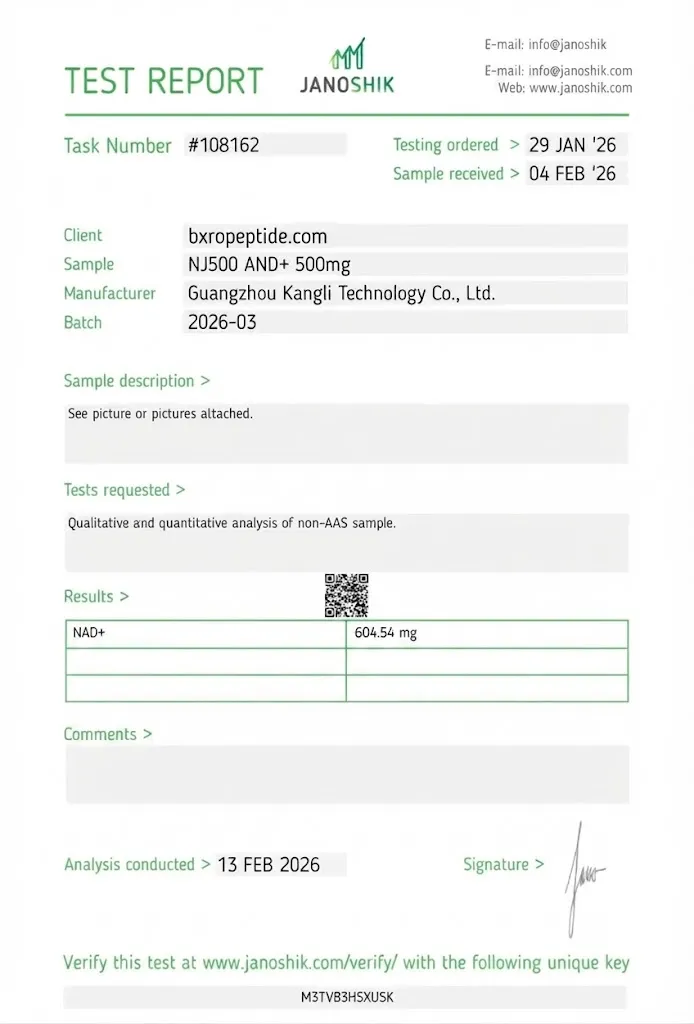
Certificate of Analysis (COA)
A Certificate of Analysis documents selected test results for a material or batch. Its usefulness depends on the tests performed, the methods used, the specifications applied, and the reliability of the laboratory and report.
When reviewing a COA, consider whether:
- The report corresponds to the specific batch being evaluated.
- The sample identity and batch number are clearly documented.
- The analytical methods are appropriate for the claims being made.
- Identity and purity results are clearly distinguished.
- Relevant additional tests are included when required for the intended application.
- The report’s source and authenticity can be verified.
- The results are reported against clearly defined specifications.
A COA may support an assessment of specified quality attributes. It does not independently demonstrate clinical safety, therapeutic effectiveness, regulatory authorization, or suitability for human administration.
For pharmaceutical development, analytical characterization should be considered alongside manufacturing controls, stability data, and other applicable quality requirements.
The EMA’s synthetic peptide development and manufacturing guideline provides a useful regulatory reference for understanding the broader context of peptide characterization and quality control.
6. Approved Peptide Medications vs. Experimental Peptides
Approved peptide medications and experimental research compounds may differ substantially in their evidence base, quality controls, and regulatory status.
| Evaluation factor | Approved peptide medication | Experimental research peptide |
|---|---|---|
| Human safety evidence | Evaluated under the applicable regulatory framework for specific indications | May be limited, preliminary, or unavailable |
| Adverse reaction information | Described in product-specific labeling and supplemented by safety monitoring | May be incompletely characterized |
| Quality requirements | Subject to applicable pharmaceutical quality and regulatory requirements | Depends on the intended use, specifications, and applicable regulations |
| Evidence of effectiveness | Evaluated for approved uses under the relevant regulatory framework | May be based primarily on laboratory or animal studies |
| Appropriate use | According to approved labeling and qualified medical guidance | Research status does not establish suitability for human use |
An approved medication is not risk-free. Its known benefits, adverse reactions, contraindications, and precautions must be considered for the particular patient and approved indication.
Conversely, a compound investigated in laboratory or animal studies should not be presumed safe or effective in humans. Preclinical findings can help inform further research, but they do not automatically establish clinical benefit.
The same principle applies to compounded drugs. As the FDA explains, compounded drugs are not FDA-approved, and they do not undergo the same premarket evaluation for safety, effectiveness, and quality as approved drugs.
For further information, consult FDA — Compounding and the FDA: Questions and Answers.
When evaluating a specific peptide, prioritize official prescribing information for approved medicines, regulatory safety communications, well-designed human clinical trials, and peer-reviewed research relevant to the exact molecule and intended use.
7. How to Evaluate Peptide Safety Information Responsibly
A reliable evaluation starts with the identity and intended use of the substance rather than the general label “peptide.”
First, establish whether the compound is an approved medication, an investigational substance, a cosmetic ingredient, or a material intended exclusively for laboratory research. The applicable safety requirements and evidence will differ by category and jurisdiction.
Next, assess the available evidence systematically.
- Regulatory information: Check relevant official databases, prescribing information, and safety advisories.
- Clinical evidence: Determine whether controlled human studies exist and whether they address the specific risks being discussed.
- Product identity: Determine whether the material has been appropriately characterized.
- Analytical documentation: Understand what the reported tests measure and what they cannot establish.
- Manufacturing and handling: Consider whether the controls are appropriate for the product’s intended application.
- Evidence limitations: Distinguish established findings from hypotheses, preliminary observations, and anecdotal reports.
How to Interpret Different Types of Evidence
Not all scientific or regulatory statements mean the same thing.
- Established adverse reactions: Reactions supported by relevant clinical or regulatory evidence.
- Potential safety concerns: Identified issues that warrant attention, although their likelihood or causal relationship may not be fully established.
- Limited human safety data: Insufficient evidence to reliably characterize the risks in humans.
- Safety or effectiveness not established: The available evidence does not support a reliable conclusion that the substance is safe or effective for the proposed use.
These distinctions are especially important when evaluating experimental peptides. Limited evidence does not prove that a compound is harmless, but it also does not establish that every proposed adverse effect will occur.
For medical decisions, consult a qualified healthcare professional. Research-use materials should not be treated as substitutes for approved medicines or used for self-experimentation.
Anyone experiencing concerning symptoms after using a peptide product should seek medical advice promptly. Severe or rapidly worsening symptoms require emergency medical attention.
Frequently Asked Questions
Do peptides have long-term side effects?
The available evidence varies by peptide. Some approved medications have substantial clinical and post-marketing safety data, while many experimental compounds lack adequate long-term human studies.
When long-term evidence is limited, the frequency and severity of possible delayed effects may remain uncertain. The absence of documented long-term harm should not be interpreted as proof that no risk exists.
Are natural peptides safer than synthetic peptides?
Not necessarily. Safety depends on the specific molecule, biological activity, exposure, formulation, and quality.
Natural origin alone does not establish safety, and synthetic origin alone does not establish danger. Both naturally derived and synthetic substances require evaluation appropriate to their intended use.
Can peptide impurities affect product quality?
Yes. The significance of an impurity depends on its identity, amount, biological activity, and intended use.
Appropriate analytical methods and manufacturing controls help characterize and manage these risks. However, the detection of a high purity percentage does not automatically establish that all relevant impurities have been identified or adequately controlled.
Does a COA prove that a peptide is safe?
No. A COA documents specified analytical results for a particular sample or batch.
It does not independently establish clinical safety, therapeutic effectiveness, regulatory approval, or suitability for human administration. Its evidentiary value depends on the test methods, sample traceability, laboratory competence, and scope of the analysis.
Are all research peptides approved for human use?
No. A research-use designation does not indicate authorization for human use.
Regulatory status depends on the substance, product, intended use, and jurisdiction. A material intended for laboratory investigation should not be assumed suitable for administration to humans.
Where can I find reliable information about peptide safety?
Start with official regulatory sources, approved product labeling, well-designed clinical trials, and peer-reviewed research.
Useful starting points include:
- Health Canada — Peptides: Health Risks
- FDA — Certain Bulk Drug Substances That May Present Significant Safety Risks
- FDA — Compounding and the FDA: Questions and Answers
- EMA — Development and Manufacture of Synthetic Peptides
For approved medicines, consult the latest product-specific prescribing information rather than relying on generalized claims about peptide safety.
Conclusion
Peptides are a diverse group of molecules, and their potential side effects cannot be assessed using a single general rule. Safety depends on the specific compound, biological activity, route of administration, available clinical evidence, and product quality.
Approved peptide medications have product-specific safety information that should guide their appropriate use. Experimental research peptides may present additional uncertainties when human evidence, manufacturing controls, or product identity are insufficiently established.
Analytical testing plays an important role in assessing peptide materials, but purity percentages, mass measurements, and Certificates of Analysis each have limitations. None independently establishes that a substance is safe or effective for human use.
The most reliable approach is to evaluate the exact molecule, consult authoritative regulatory information, distinguish established findings from unresolved concerns, and seek qualified medical guidance when making treatment decisions.
Scientific evidence—not marketing claims, purity percentages, or isolated testimonials—should guide conclusions about the risks of any specific peptide.
References and Further Reading
The following official resources provide further information on peptide safety, regulatory oversight, approved medicines, and synthetic peptide quality.
1. Peptide Safety and Regulatory Warnings
Health Canada — Peptides: Health Risks
Official guidance on the risks associated with unauthorized peptide products, including contamination, incorrect labeling, adverse reactions, and the limitations of third-party testing.
https://www.canada.ca/en/health-canada/services/drugs-health-products/peptides/health-risks.html
Health Canada — Think Twice Before Injecting Peptides Bought Online
A public health advisory describing risks associated with unauthorized injectable peptides marketed for bodybuilding, weight loss, injury recovery, anti-aging, and wellness.
U.S. Food and Drug Administration (FDA) — Certain Bulk Drug Substances for Use in Compounding That May Present Significant Safety Risks
Regulatory information on safety uncertainties associated with selected peptide substances, including BPC-157 and CJC-1295.
2. Approved Peptide Medications and Drug Quality
FDA — Wegovy (Semaglutide) Prescribing Information
Official product labeling describing approved indications, contraindications, warnings, precautions, and adverse reactions.
https://www.accessdata.fda.gov/drugsatfda_docs/label/2025/215256s024lbl.pdf
FDA — Compounding and the FDA: Questions and Answers
An explanation of the regulatory distinction between FDA-approved medicines and compounded drugs, including the limitations of premarket review for compounded products.
https://www.fda.gov/drugs/human-drug-compounding/compounding-and-fda-questions-and-answers
3. Synthetic Peptide Quality and Manufacturing
European Medicines Agency (EMA) — Guideline on the Development and Manufacture of Synthetic Peptides
Scientific and regulatory guidance addressing synthetic peptide manufacturing, molecular characterization, specifications, analytical controls, impurities, and related quality considerations. The current guideline became legally effective on June 1, 2026.
https://www.ema.europa.eu/en/scientific-guidelines/development-manufacture-synthetic-peptides
Reference Interpretation
Regulatory warnings, prescribing information, and manufacturing guidelines address different questions. A safety warning identifies a potential concern; prescribing information describes known risks and precautions for a specific medicine; and manufacturing guidance addresses development and product quality.
These resources should be interpreted in the context of the specific molecule, formulation, route of administration, intended use, and jurisdiction. They do not establish that all peptides share the same safety profile.
References last reviewed: October 2026. Regulatory information and product labeling may change. Consult the latest official documents when making medical or scientific decisions.
Disclaimer: This article is for general educational purposes only and is not medical advice. Research-use materials are not substitutes for approved medicines. Consult a qualified healthcare professional about medical decisions, potential interactions, and adverse effects.